
14.02.2026, 00:01
Reanimal Review
The minds behind Little Nightmares unveil a new chapter of dark puzzle platforming honed over years.
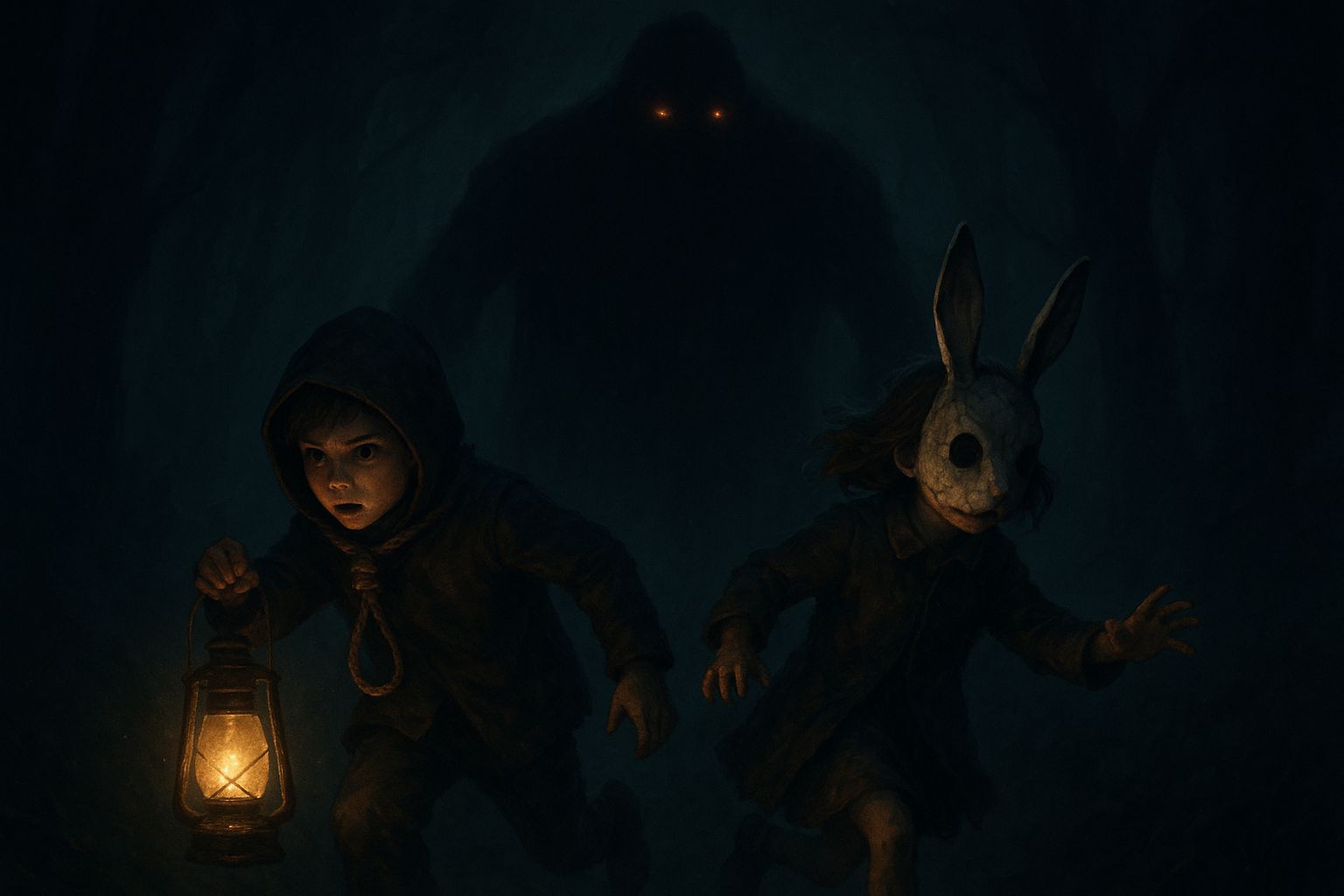
"Hell is not other people. Hell is yourself." - Ludwig Wittgenstein The journey commences with a group of children peering into a dark abyss. A boy, cloaked in a hood with remnants of a hangman’s noose around his neck, navigates a small boat adrift on the open sea. The origins of his voyage and his destination remain a mystery, as does whether he was amongst those who once gazed into the depths of that well. All I know is the path ahead, marked by flickering red lights peeking through the gloom. They serve as my guide, leading me onward. These buoys, mysterious in nature, hint at an unknown destination. The ocean stretches infinitely, dwarfing my tiny vessel. For a moment, solitude envelops me. At the fourth buoy, the boy halts the boat and helps a girl aboard. When he reaches for the hare mask obscuring her face, she forcefully pins him down, ripping at his mask until he manages to push her away. They exchange glances from opposite ends of the boat, a chasm of uncertainty separating them. "I thought you were dead," the boy says. "Where are the others?" inquires the girl. The boy is at a loss. She grabs a lantern and takes position at the front of the boat, illuminating the path ahead. The buoys still guide us, but now the girl sheds light on our route. As I venture through Reanimal, the latest horror puzzle platformer from Tarsier Studios, the details of this opening scene fade from memory. My focus shifts to deciphering the meaning behind what I’ve witnessed, piecing together the narrative of Reanimal. Yet, good stories, the ones that know their purpose, reveal their essence from the outset. Reanimal is indeed a masterful tale. It implores you to remember. In this adventure, I embody the boy while my co-op partner takes on the role of the girl. There’s no selection process; it simply unfolds this way. Together, we navigate through jagged cliffs, past colossal mines that loom over our boat, and traverse a forest filled with twisted, barren trees. Soon, the riverbanks fade, revealing an imposing industrial structure shrouded in fog—a striking image in a game rich with visual splendor. The narrative is subtle, leaving much unsaid. The boy and girl are siblings, a detail revealed through their actions rather than explicit dialogue. You grasp their bond through moments of support and comfort, with the story inviting you to ponder unanswered questions. Why does she lash out after he rescues her? What events led them to this boat? Reanimal unfolds its narrative gradually, urging players to connect the dots and recognize the thematic elements woven throughout its world. When we encounter another child confined behind steel bars, he whispers, "You came back. I knew you would. You should leave… while you still can." But we press on. The girl’s earlier query provides clarity: we have come to rescue our friends. While Reanimal can be experienced solo, sharing the journey with another player enhances its impact. We traverse dilapidated structures, push through shadowy woods, leap over wide gaps, and squeeze into spaces only children can access. Cooperation is essential; the world feels immense, and we are small. Together, we must lift a heavy metal trapdoor. I stabilize a rotating shaft while my partner guides the girl across. Once on the other side, she clears a wooden obstacle for me to cross. The mechanics are simple yet effective. Players engage in walking, running, jumping, interacting with, and moving objects, assisting one another to reach otherwise inaccessible heights, and occasionally battling foes in a manner befitting a child. The boy and girl are largely indistinguishable, except the girl can attach her lantern to her hip, allowing her to carry items simultaneously. In contrast, the boy’s lighter requires his hands to be free. This distinction subtly influences our decisions about responsibilities based on light management and our willingness to make sacrifices. Though Reanimal offers a solo mode, I found collaborating with another player immensely fulfilling. We celebrated our achievements and discussed our setbacks, fostering a shared experience akin to that of the characters on-screen. Unlike a predictable AI-controlled partner, the dynamic of working with a real person enriched the adventure, making me appreciate the local co-op feature in a gaming landscape that often overlooks it. Both the gameplay and the choices presented in Reanimal are engaging yet straightforward. It feels less like a conventional game and more like an immersive world to explore without the intrusive elements typical of video games. There are no HUDs, no meters, and no minimaps. The camera often remains fixed, showcasing precisely what Tarsier intends you to see, and the visual composition is exceptional. Even horror can possess beauty when captured through the right lens. The solutions to the gameplay challenges are often apparent, yet this does not detract from the satisfaction, as the real motivation propelling us forward is the desire to unveil what lies ahead. If you anticipate groundbreaking innovations compared to the previous Little Nightmares installments, you may be disappointed; however, I find no issue with this. One doesn't visit a favorite restaurant resentful that the menu remains unchanged, especially when the chef is a master of their craft. But the environment is not our only source of peril. As we search for missing wheels for a handcar, we encounter unsettling sights—a body slumped against a wall with a gaping hole in its abdomen. A plunger used on a clogged toilet reveals both a key and the grotesque, deflated skin of what once was a man, his visage a disturbing blend of human and pig. It isn’t until we locate the second wheel that the true horror reveals itself: the skins of man and animal around us animate, slithering toward us like serpents. We respond instinctively—running is our only option. The terror escalates as we come face-to-face with a towering figure, his face an unsettling mask of sagging skin and hollow eye sockets. He pursues us with a spider-like agility, ready to snatch our heads if we falter. Yet, he is only the beginning of the horrors that await. Much of Reanimal revolves around fleeing from threats, but I won’t divulge more; these are experiences best encountered firsthand. What I can affirm is that the realm the boy and girl have returned to feels fundamentally wrong. There exists a theory that hell consists of the most agonizing moments of your life, looping endlessly, familiar yet fresh. What does it imply that the boy and girl appear to have returned here willingly after escaping? "I told you to leave," warns the boy we meet later. Or are they all ensnared in this place, trapped in a hell of their own making? One truth prevails: we have ventured beyond the edge of the map. Here be dragons. As our adventure progresses, the world unfolds around us. We navigate through shadowy forests, submerged city ruins, and active conflict zones. The cause of this devastation remains partially shrouded in mystery. Our path is not strictly linear; returning to the boat allows for exploration beyond the main route. Here, Reanimal reveals its nature as a video game, rewarding curiosity with new masks, collectible concept art, and more, yet it never feels forced or artificial.